 Luxury Inca Trail
Inca Trail vs Salkantay
Inca Trail vs Salkantay is the choice most trekkers face when permits or dates fail. The Inca Trail is a regulated trail of about 42 kilometres (other sources give 39 to 45) with a 500-person daily permit cap and Inca ruins the whole way. Salkantay is longer, higher and needs no hiking permit, trading ruins for a pass listed at 4,600 to 4,660 metres and a glacial lake. This page compares both treks honestly: length, altitude, permits, crowds, sleeping, and the tours that book them, with the figures each source gives. The bookable tours are compared on all luxury Inca Trail tours.
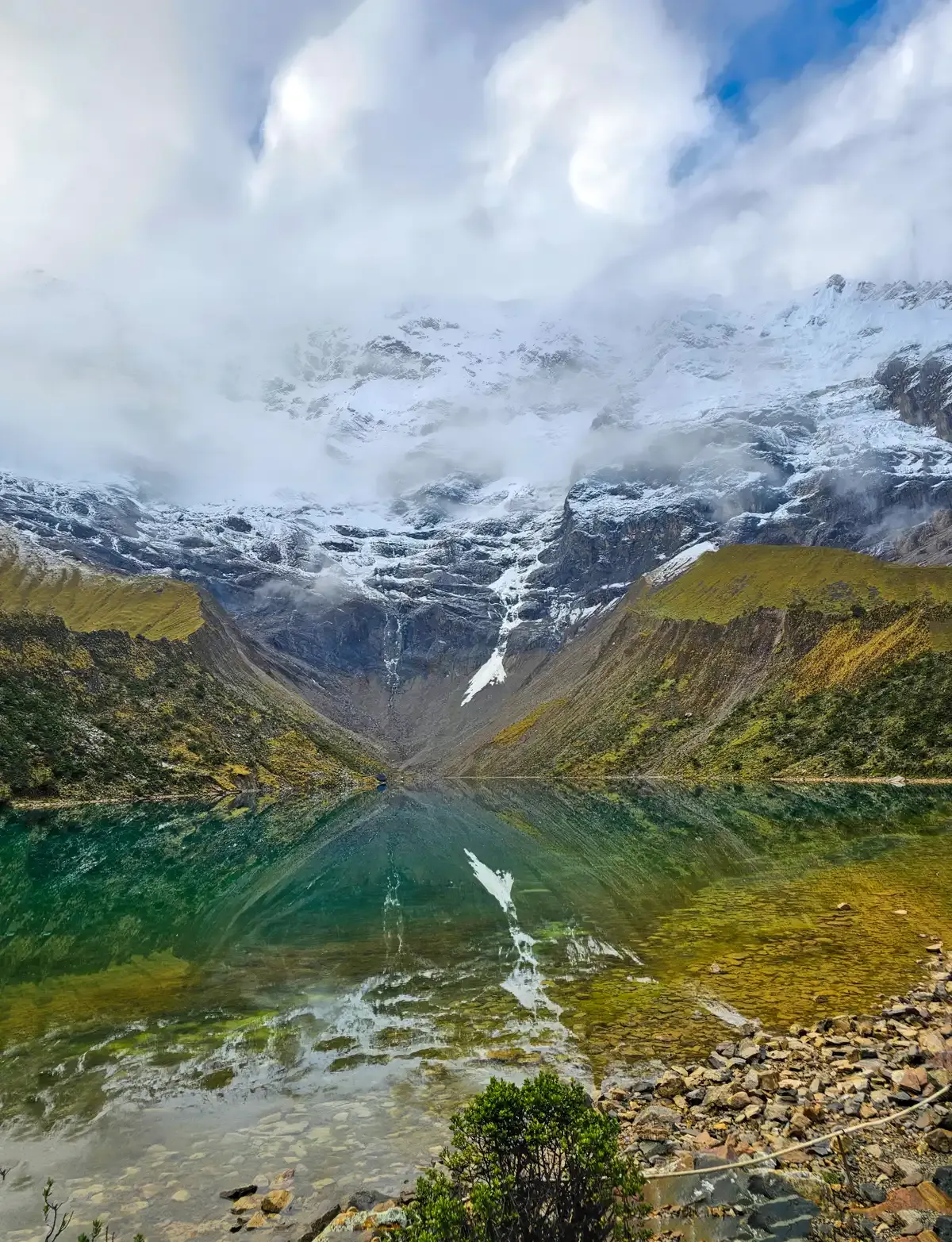
Humantay Lake near Soraypampa, on the Salkantay route. Photo: Steve FUNG, CC BY-SA 4.0, via Wikimedia Commons
Quick answer Inca Trail or Salkantay
For Inca Trail vs Salkantay, the Inca Trail is about 42 kilometres over 4 to 5 days with a capped permit of 500 people a day, while Salkantay runs roughly 74 kilometres over about 5 days, crosses a pass listed at 4,600 to 4,660 metres and needs no hiking permit. The Inca Trail wins on ruins and the Sun Gate arrival. Salkantay wins on availability, scenery and altitude drama. Book the Inca Trail well ahead for the dry season, with operators advising 4 to 8 months, or pick Salkantay if permits are gone.
Key takeaways
- Want ruins and the classic arrival on foot through the Sun Gate (Inti Punku)? The classic 4-day Inca Trail with the train back to Ollantaytambo costs $835 per person with permits and the Machu Picchu ticket included.
- Want both routes in one trip? The 7-day Salkantay and Inca Trail at $1,555 per person links Humantay Lake, Salkantay Pass and the classic trail.
- Check permit rules, the 500-a-day cap and the February closure in the Inca Trail permits guide before you commit to dates.
- See how every listed trek stacks up on price, group size and train class in the comparison table on the luxury Inca Trail tours homepage.
The Two Treks Side by Side
Both treks end at Machu Picchu, but almost everything else differs. This table sets the core figures next to each other.
The Numbers at a Glance
The figures below come from the sources on record. Where sources disagree, both numbers are shown. The Inca Trail column uses the classic 4-day route from Km 82.
The Salkantay column uses the full route as listed by TourRadar and Salkantay Trekking.
| Feature | Inca Trail | Salkantay |
|---|---|---|
| Length | 42 km (26 mi), with other sources at 38.9 to 45 km | 74 km in 5 days per TourRadar, or 57.5 km in 4 days per Salkantay Trekking |
| Days | 4 to 5 | 4 to 5 for the short trek, 5 for the full route |
| High point | Dead Woman's Pass 4,215 m (13,829 ft), other sources 4,200 m or 4,222 m | Salkantay Pass 4,630 m, other sources 4,600 to 4,660 m |
| Permit | Capped at 500 people a day including about 200 trekkers, sold through authorised agencies only | No hiking permit. A Machu Picchu ticket is required |
| Ruins | Patallaqta, Runkurakay, Sayacmarca, Phuyupatamarca, Wiñay Wayna and more | Relatively few ruins compared with the Inca Trail, per KimKim |
| Arrival at Machu Picchu | On foot through the Sun Gate (Inti Punku) at about 2,720 to 2,745 m | Bus from Aguas Calientes up to Machu Picchu for a guided tour |
| Crowds | About 200 tourists a day per KimKim, and peak season permits sell out fastest | About 50 hikers a day per KimKim |
| Sleeping | Camping. Luxury camps typically add large tents, mattresses, mess tents, portable showers and toilet tents | Camping or lodges. Salkantay Trekking's short trek lists glass igloos at Sky Camp (3,900 m) and luxury domes at Mountain Sky View (2,950 m), and Mountain Lodges of Peru runs a 7-day lodge trek |
What the Numbers Mean in Practice
The permit is the real difference. The Inca Trail has had a quota system since 2001, and before the early 2000s more than 1,000 people a day were hiking it. Today only 500 permits a day exist, about 200 of them for trekkers, and hiking without an authorised agency is not allowed. Peak season permits for May to September sell out fastest, and operators advise booking 4 to 8 months ahead. Salkantay has no such cap, so you can decide later.
Altitude cuts the other way. Salkantay Pass is roughly 400 metres higher than Dead Woman's Pass, and Exploor Peru rates Salkantay as strenuous at 6 to 10 hours a day against the Inca Trail's moderate 6 to 7 hours. The Inca Trail shuts every February for maintenance and reopens on 1 March, while no February closure is stated for Salkantay.
On price, the classic Inca Trail starts at $798 per person for the 4-Day Inca Trail with Panoramic Train and reaches $6,222 per person for the fully private Luxury 4-Day Inca Trail with massage therapists and paired wines. The 7-day trek that does both routes sits between them at $1,555 per person.
Why Pick the Inca Trail
The Inca Trail walks into Machu Picchu on foot, past ruin after ruin. That is the whole argument, and it is a strong one.
The Ruins on the Way
No other route to Machu Picchu carries this much archaeology on the path itself. Each of these sits on or beside the trail:
- Patallaqta, 1.5 km from the classic start, with about 100 structures and a shrine called Pulpituyuq. Manco Inca Yupanqui burned it in 1536. - Runkurakay at 3,760 metres, a ruin whose name comes from Quechua runku (basket) and raqay (shed), heavily restored in the late 1990s. - Sayacmarca at 3,600 metres, meaning Inaccessible Town, with a Temple of the Sun and a labyrinth of residences. Hiram Bingham III visited it in April 1915 and called it Cedrobamba. - Phuyupatamarca, the City above the Clouds, with five ceremonial fountains whose water systems still function. - Wiñay Wayna, a ceremonial and agricultural centre 4 km from Machu Picchu with as many as 19 springs. The final descent to it covers roughly 1,500 carved steps over about 1,000 metres.
The Sun Gate Arrival
The Inca Trail delivers you to Machu Picchu on foot through the Sun Gate (Inti Punku), at about 2,720 to 2,745 metres depending on the source. Trekkers arriving on the trail network enter on Circuit 3-B, which covers the agricultural zone, the Temple of the Sun and the House of the Inca. Trek dates must match the citadel entry date for same-day entry.
This on-foot arrival is what Salkantay does not offer. Salkantay hikers view Machu Picchu from afar on the final day and visit it the next day, arriving by bus from Aguas Calientes.
Permits and What the Cap Really Means
Permits are capped at 500 people per day, of which about 200 go to trekkers and about 300 to guides, porters and support staff. They are issued to one person on one passport, and they are non-transferable and non-refundable. They are sold only through Ministry of Culture authorised agencies.
The trail also closes every February for maintenance and reopens on 1 March. Machu Picchu citadel itself stays open all year even when the trail is shut. A difficult detail: permits that include Circuit 3-B entry are scarce and can sell out months in advance, so book early or read the Inca Trail permits guide for the release calendar.
Inca Trail vs Salkantay Trek to Machu Picchu
The two routes compared. Third-party video by TourRadar. This site did not shoot it and has no relationship with the creator.
Why Pick Salkantay
Salkantay is the bigger, wilder walk: a higher pass, a glacial lake and no permit cap. Wikipedia calls it the alternative to the oversubscribed Inca Trail, and the name itself comes from Quechua sallqa, wild or savage.
The Mountain and Humantay Lake
Salcantay mountain stands at 6,271 m (20,574 ft) or 6,264 m (20,551 ft) depending on the source, the 12th highest peak in Peru and about 60 km west-northwest of Cusco. The trek crosses Salkantay Pass at 4,630 metres per Salkantay Trekking, though other sources give 4,600, 4,650 or 4,660 metres, so it is about 400 metres above Dead Woman's Pass whichever figure you take. Humantay Lake sits at 4,200 metres (13,780 feet) and is reached from Soraypampa.
The route then drops through subtropical cloud forest and past a local coffee farm, so you walk from glacier country into almost tropical green in a few days. The dry season runs from late April to mid-October.
No Permit and Fewer People
Salkantay needs no hiking permit, only a Machu Picchu ticket, which removes the single biggest planning problem on the Inca Trail. KimKim puts Salkantay traffic at about 50 hikers a day against roughly 200 tourists on the Inca Trail, and that gap widens once Inca Trail permits for the dry season sell out. The trade is honest: KimKim notes Salkantay has relatively few ruins compared with the Inca Trail, and the arrival is by bus rather than on foot through the Sun Gate.
If ruins and the classic entrance matter most, Salkantay will disappoint. If solitude and high scenery matter more, it is the easier yes. Trekkers who want both can look at the 7-Day Salkantay and Inca Trail, which links Humantay Lake and Salkantay Pass with the classic trail's ruins and Sun Gate finish.
Where You Sleep
Salkantay's sleeping options run wider than the Inca Trail's. TourRadar lists both camping and lodge options. Salkantay Trekking's short trek sleeps one night at Sky Camp at 3,900 metres, which has glass igloos, and one at Mountain Sky View at 2,950 metres, which has luxury domes, with the last night in a hotel in Aguas Calientes.
A separate lodge-to-lodge option exists too: Mountain Lodges of Peru runs a 7-day lodge trek crossing the pass at 4,600 metres and using four lodges, with a retailer listing Salkantay Lodge at 12,690 feet, Wayra Lodge at 3,906 metres and Colpa Lodge at 2,870 metres. That lodge trek is not the Inca Trail. On the classic Inca Trail, by contrast, the sleeping is camping, and the upgrade is the camp itself: luxury camps typically bring large tents, quality mattresses, a mess tent and toilet tents.
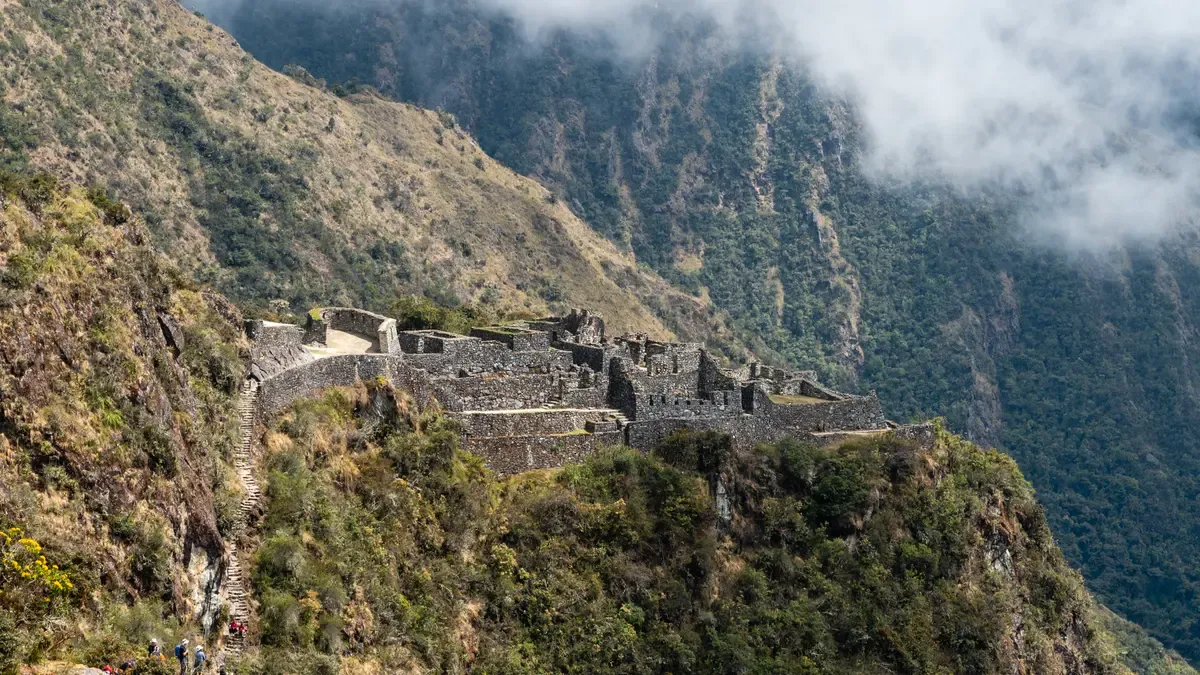
Sayacmarca on the Inca Trail. Photo: Christoph Strässler, CC BY-SA 2.0, via Wikimedia Commons
Which Is Harder
Both treks cross high passes, but the Salkantay route goes higher and, on most listings, covers more ground. The figures below come from operator pages and reference sites, and they disagree in places.
The Numbers Side By Side
Sources do not agree on the basics, so both sides are given. The Inca Trail length is listed as 42 km (26 miles) by Wikipedia, 44 km by Salkantay Trekking, 45 km by Valencia Travel, while Andean Trails' day distances add to 38.9 km. For the Salkantay, Salkantay Trekking's short trek covers 57.5 km in 4 days and TourRadar gives the full route as 74 km over 5 days.
The Salkantay Pass sits at 4,630 m per Salkantay Trekking, or 4,600 m per TourRadar, which is clearly above Dead Woman's Pass at 4,215 m (or 4,200 m on its own Wikipedia page). Exploor Peru rates the Salkantay trek strenuous at 6 to 10 hours a day and the Inca Trail moderate at 6 to 7 hours.
| Feature | Inca Trail | Salkantay |
|---|---|---|
| High pass | Dead Woman's Pass, 4,215 m (13,829 ft), other sources say 4,200 m or 4,222 m | Salkantay Pass, 4,630 m (15,190 ft) per Salkantay Trekking, 4,600 m per TourRadar |
| Length | 42 km (26 miles) per Wikipedia, 44-45 km per other operators, 38.9 km by day sums | 57.5 km in 4 days per Salkantay Trekking, 74 km in 5 days per TourRadar |
| Days | Usually 4 to 5 days | 4 to 5 days |
| Steepest day | Day 2, starting about 5:30 a.m., with a 4 to 5 hour climb from camp to Dead Woman's Pass | The Salkantay Pass day, with 23.5 km walked on day 2 of the short 4-day trek |
| Rating | Moderate to challenging per Salkantay Trekking | Moderate to challenging per Salkantay Trekking, strenuous per Exploor Peru |
Altitude And Acclimatisation
The Salkantay route takes you roughly 400 metres higher than the Inca Trail, and altitude sickness can appear from about 2,500 metres, so both treks cross into the risk zone. Cusco sits at roughly 3,200 to 3,450 metres depending on the source, and the 7-day Salkantay and Inca Trail listing recommends arriving in Cusco at least 2 days early. Above 3,000 metres, sleeping altitude should rise by no more than about 500 metres a day.
Common symptoms are headache, nausea, fatigue and poor sleep. A typical acetazolamide prevention dose is 125 mg twice daily starting the day before ascent, which is a matter to discuss with a doctor. The Salkantay's Sky Camp sits at 3,900 metres, a high place to sleep, while Inca Trail camps such as Llulluch'apampa at about 3,800 metres are similarly high.
Machu Picchu itself is nearly 1,000 metres lower than Cusco at about 2,430 metres on the trail's lowest point, so the final day is easier on the lungs. Read more in the guide to Dead Woman's Pass.
Weather And The February Closure
The two routes face the same seasons but not the same rules. The Inca Trail closes every February for maintenance, covering routes 1, 2, 3, 5 and 6 of the network, and reopens on 1 March. About 60 specialists repair stonework, stabilise terraces, clear vegetation and inspect bridges during the closure.
The 2025 closure ran to late March because of heavy rain. No February closure is stated for the Salkantay trek, which runs on trails without the Inca Trail permit system, though February is the height of the rainy season, with heavy rain, landslides, fog and swollen rivers. The dry season runs from April to October, with July and August rated the most stable trekking conditions and nights in June and July on the Inca Trail able to reach freezing.
Cusco's record low is minus 7.0 C. April and May are balanced shoulder months with fewer crowds. Plan around the closure with the page on the best time to hike the Inca Trail.
Sources: Wikipedia, Inca Trail to Machu Picchu and Salkantay Trekking
Doing Both in One Trip
You do not have to choose. One listing here walks the Salkantay route and then joins the Classic Inca Trail to the Sun Gate.
The 7-Day Salkantay And Inca Trail Trek
The 7-Day Salkantay and Inca Trail costs $1,555 per person for 7 days and 6 nights in a group of up to 12. It covers 6 nights of camping, including 1 night at Sky Camp in Soraypampa. The route goes to Humantay Lake at 4,200 metres and over the Salkantay Pass, then joins the Classic Inca Trail to the Sun Gate.
The price includes permits and tickets for the Inca Trail, entry fees for the Salkantay Trek and Humantay Lake, and Machu Picchu entrance for Circuit 1C and Circuit 3B. An expert chef, porters and horsemen travel with the group, each hiker gets a personal duffel bag for up to 5 kg, and walkie-talkies, oxygen and emergency satellite phones are carried. Optional horseback rides from Soraypampa to Humantay Lake and to Salkantay Pass are not included.
The return is the panoramic tourist train from Aguas Calientes to Ollantaytambo. The listing is non-refundable and advises booking five months ahead. Full details are on the Salkantay and Inca Trail 7 days page.
For shorter options, compare the 4-day treks on Inca Trail with Vistadome Train, which costs $835, or read about luxury Inca Trail tours more broadly.
When The Classic Alone Is Enough
Seven days of walking with six nights of camping is a serious commitment, and the combo asks for strong legs and a full week of holiday. If your priority is the ruins rather than the mountain scenery, the Classic Inca Trail alone delivers the Inca sites that Salkantay largely lacks, since KimKim notes the Salkantay route has relatively few ruins. The 4-Day Inca Trail with Vistadome Train at $835 covers the classic route and the Sun Gate arrival in 4 days.
If you want the most comfortable version of the classic, the Luxury 4-Day Inca Trail at $6,222 adds ultra-luxury camping, a massage therapist at every camp and Peruvian wine with the meals. Neither shorter trek includes the Salkantay Pass, Humantay Lake or a night at Sky Camp, so the choice comes down to landscape versus time and budget.
Tips For Choosing Between The Two
Do
- Do acclimatise in Cusco for a few days before either trek, because Cusco sits at roughly 3,200 to 3,450 metres and sleeping altitude should rise by no more than about 500 metres a day above 3,000 metres.
- Do book the Inca Trail 4 to 8 months ahead for the dry season, because permits are capped at 500 people per day, only about 200 of them trekkers, and May to September permits sell out fastest.
- Do consider Salkantay if the Inca Trail is sold out, because Wikipedia calls it the alternative to the oversubscribed Inca Trail and it needs no hiking permit, only a Machu Picchu ticket.
- Do pack for freezing nights on either route, because Inca Trail nights in June and July can reach freezing and the Salkantay's Sky Camp sleeps at 3,900 metres.
- Do check which Machu Picchu circuit your Inca Trail permit includes, because trekkers arriving on the trail use Circuit 3-B, which covers the agricultural zone, the Temple of the Sun and the House of the Inca.
Don't
- Don't plan an Inca Trail trek in February, because the trail closes every February for maintenance and reopened on 1 March after the 2026 closure.
- Don't assume the Salkantay is easier because it has no permit, because Exploor Peru rates it strenuous at 6 to 10 hours a day against 6 to 7 hours on the Inca Trail.
- Don't expect Inca ruins along the Salkantay, because KimKim notes the Salkantay trek has relatively few ruins compared with the Inca Trail and its sites such as Phuyupatamarca, with five ceremonial fountains, and Wiñay Wayna sit on the Inca Trail.
- Don't take Salkantay if you view Machu Picchu on the final day as your only visit, because KimKim says Salkantay hikers view the citadel from afar on the last day and visit it the next day, so plan for that extra morning.
Inca Trail vs Salkantay Questions
Which trek is harder, the Inca Trail or the Salkantay?
Exploor Peru rates the Salkantay as the harder walk, strenuous at 6 to 10 hours a day against 6 to 7 on the Inca Trail. Its pass is listed at 4,600 to 4,660 metres against 4,200 to 4,215 metres at Dead Woman's Pass.
How long is each trek?
The Inca Trail is about 42 km over 4 to 5 days. The Salkantay figures vary by operator, from 57.5 km in 4 days to 74 km in 5 days. Day-by-day route detail is on the Inca Trail page.
Does the Salkantay trek need a permit?
No hiking permit is needed for the Salkantay, but a Machu Picchu ticket is required. The Inca Trail needs a permit capped at 500 people per day, including about 200 trekkers. The rules are explained on the Inca Trail permits page.
Can I hike in February?
The Inca Trail closes every February for maintenance and reopens on 1 March, and the 2025 closure ran to late March because of heavy rain. The Salkantay has no stated February closure, though February is the height of the rainy season. Season advice is on the best time to hike the Inca Trail page.
How do the two treks arrive at Machu Picchu?
Inca Trail hikers walk in through the Sun Gate at about 2,720 to 2,745 metres. Salkantay hikers view the citadel on the final day and take a bus from Aguas Calientes up to Machu Picchu for a guided tour. The Sun Gate arrival is described on the Sun Gate Machu Picchu page.
Can I do both treks in one trip?
Yes. The 7-Day Salkantay and Inca Trail at $1,555 per person links the Salkantay route, including Humantay Lake and a night at Sky Camp, with the Classic Inca Trail to the Sun Gate, permits and Machu Picchu entry included.
Want both routes in one trek? The 7-Day Salkantay and Inca Trail walks the Salkantay Pass, Sky Camp and the Classic Inca Trail to the Sun Gate.
Permits, Machu Picchu entry and the panoramic train back are included in the $1,555 price.