 Luxury Inca Trail
The Inca Trail: Route, Elevations and Difficulty
The Inca Trail is the stone road of roughly 42 kilometres (sources range up to 45) from Km 82 to Machu Picchu, walked over 4 or 5 days across three high passes. This guide maps the route stage by stage, gives the elevations, describes the ruins along the way and explains how hard it is. It also covers who can hike it, since permits are capped and sold only through licensed operators. For prices and inclusions, compare the bookable luxury Inca Trail tours on the homepage before you commit.
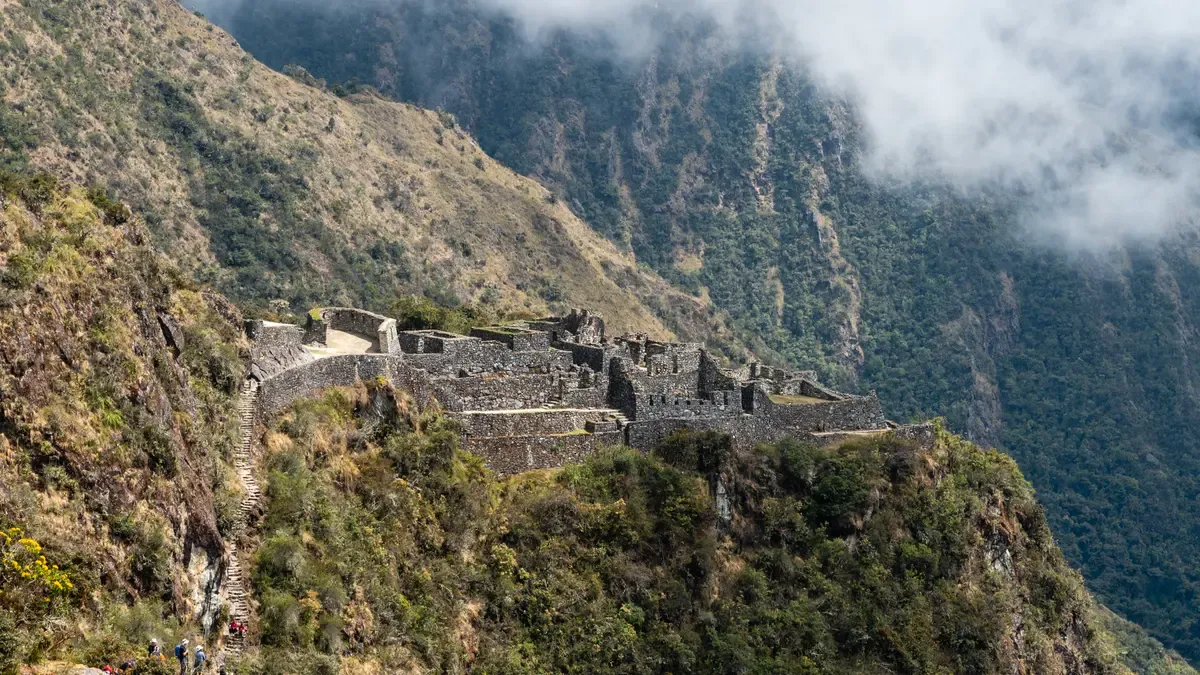
Sayacmarca, passed on day 3. Photo: Christoph Strässler, CC BY-SA 2.0, via Wikimedia Commons
Quick answer The Inca Trail in brief
The Inca Trail is a stone road of roughly 42 kilometres (26 miles, with some sources saying 44 or 45) from Km 82 to Machu Picchu, usually walked in 4 to 5 days, with a high point of about 4,200 metres at Dead Woman's Pass. Only 500 people may start per day, of whom about 200 are trekkers, and every one of them must go with a licensed operator. Independent hiking is not allowed.
Key takeaways
- See how the 4 days break down in the 4-Day Inca Trail with Vistadome Train, the most reviewed trek on the site at 11,562 reviews.
- If 4 days of camping is too much, the Short Inca Trail with 4-Star Hotel covers the last 12 kilometres from Km 104 with a hotel night.
- The hardest moment is day 2 over Dead Woman's Pass, the trek's high point at about 4,200 metres.
- Permits sell out months ahead and the trail closes every February. The details sit in the permits and February closure section of the homepage.
What the Inca Trail Is
One famous stretch of a road system that once ran the length of the Andes, now the most regulated trek in Peru.
A Road with a Bigger Story
The trail hikers walk today is one stretch of the Qhapaq Ñan, the Inca road network that measured about 40,000 kilometres (25,000 miles), with scholarly estimates running from 23,000 to 60,000 km. UNESCO inscribed the Qhapaq Ñan Andean Road System as a World Heritage Site in 2014, across six countries. The trail itself runs through the Historic Sanctuary of Machu Picchu, a protected area declared in 1981 that spans about 20 km from snows above 4,000 metres down to rainforest just over 1,700 metres. UNESCO inscribed the sanctuary in 1983. Wikipedia lists 24 ecosystems, 75 mammal species and 444 bird species inside it, plus 423 orchid species, 332 tree species and 377 butterfly species. The spectacled bear, highland quetzal and cock-of-the-rock are among its threatened animals.
You cannot walk it alone. Permits are sold only through Ministry of Culture authorised agencies, and every hiker goes with a licensed operator and a guide. At the Km 82 checkpoint trekkers show original passports while the operator presents permits for trekkers, porters, guides and cooks. The quota system has been in place since 2001, before which more than 1,000 people per day were hiking. The trail also closes every February for maintenance. For prices on bookable treks, the Premium 4-Day Inca Trail Trek is capped at 8 hikers at $1,499 per person.
The Trail by the Numbers
Sources disagree on some headline figures, so the table below gives both sides. The length conflict matters little on the ground but appears often in operator material. Elevation figures also vary between the trailhead sources.
All figures come from the sources cited in each row of this guide.
| Fact | Figure |
|---|---|
| Length | 42 km (26 miles) per Wikipedia. Other sources give 44 km, 45 km, or day distances adding to 38.9 km |
| Start | Piscacucho (Km 82) at about 2,709 m in Ollantaytambo district. Wikipedia gives 2,600 m or 2,800 m |
| Alternative start | Qoriwayrachina (Km 88), which Wikipedia puts at 2,800 m |
| High point | Dead Woman's Pass (Warmi Wañusqa) at 4,215 m (13,829 ft), also quoted as 4,200 m and 4,222 m |
| Total ascent | About 2,500 m (8,200 ft) of elevation gain |
| Lowest point | Machu Picchu at 2,430 m |
| Duration | Usually 4 to 5 days |
| Daily permit cap | 500 people per day, of which about 200 are trekkers and 300 go to guides, porters and support staff |
The Route, Mile by Mile
A map in words: the four stages from Km 82, the three passes with their elevations, and every ruin you pass on the way to the Sun Gate.
The Four Days as a Map in Words
Operators divide the roughly 42 kilometre route into four walking days, with camp each night set by water and altitude. The table below sketches the shape of each stage. Exact daily distances vary between operators because campsites are assigned, so treat the stops below as a rough guide.
Day 2 starts around 5:30 a.m. with coffee or coca tea and is described as the most demanding day. Note that the full route cannot be walked without a permit, and permits for peak dates sell out fastest. The 4-Day Inca Trail with Panoramic Train at $798 per person follows this exact route over Dead Woman's Pass to the Sun Gate.
| Stage | From | To | High point |
|---|---|---|---|
| Day 1 | Piscacucho (Km 82), about 2,709 m | Wayllabamba, where porters are weighed a second time | Not given in the sources used here |
| Day 2 | Wayllabamba | Pakaymayu campground, about 600 m below the pass | Dead Woman's Pass at 4,215 m |
| Day 3 | Pakaymayu | Wiñay Wayna camp | Second pass at about 3,950 m, then Phuyupatamarca at 3,600 to 3,670 m |
| Day 4 | Wiñay Wayna | Machu Picchu via the Sun Gate | Sun Gate at about 2,720 to 2,745 m, citadel at 2,430 m |
The Three Passes
The trail crosses three high passes. The first and highest is Dead Woman's Pass (Warmi Wañusqa) at 4,215 metres (13,829 feet) per Wikipedia's Inca Trail article, though the pass's own Wikipedia page gives 4,200 metres (13,780 feet) and other sources print 4,222 metres. The name comes from Quechua and refers to the silhouette of a woman lying in the ridge line, best seen from Pacaymayo camp and Runkurakay.
The climb from camp takes 4 to 5 hours, and G Adventures describes day 2 as the most difficult day for many hikers. The second pass sits at about 3,950 metres, The third pass lies beyond Phuyupatamarca, which sits at 3,600 to 3,670 metres depending on the source. After the third pass the trail drops to Wiñay Wayna over roughly 1,500 carved steps covering about 1,000 metres of descent.
Passes, weather and acclimatisation all get more space on the Dead Woman's Pass page, so this page stops at the elevations.
The Ruins Along the Way
Part of what separates the Inca Trail from any other Andean trek is that the campsites sit beside Inca buildings. Six sites carry the route.
- Patallacta (Llactapata) lies 1.5 km from the trailhead at about 2,840 metres. Its name means settlement on a platform, it had about 100 structures, and Manco Inca Yupanqui burned it in 1536 during his retreat from the Spanish.
- Runkurakay at 3,760 metres means Pile of Ruins, from Quechua runku (basket) and raqay (shed). It was heavily restored in the late 1990s and offers views back to Dead Woman's Pass.
- Sayacmarca at 3,600 metres means Inaccessible Town and holds a Temple of the Sun and a labyrinth of residences. Hiram Bingham III visited it in April 1915 and called it Cedrobamba.
- Phuyupatamarca at 3,600 metres per Wikipedia and Salkantay Trekking, or 3,670 metres per Alpaca Expeditions, means City above the Clouds. Its five ceremonial fountains still run in the wet season.
- Intipata at 2,840 metres means Terrace of the Sun, a set of farming terraces on the final descent.
- Wiñay Wayna sits on a steep hillside above the Urubamba River about 4 km from Machu Picchu, with upper and lower house complexes joined by a staircase and fountains, and as many as 19 springs. Wikipedia puts the ruins at 2,650 metres, while camp figures run from 2,680 to 2,700 metres.
Inca Trail Review: Everything You Need to Know
A hiker's full review of the four days. Third-party video by Explorin with Laurin. This site did not shoot it and has no relationship with the creator.
How Hard the Inca Trail Is
The Inca Trail is rated moderate to challenging. Distance alone does not explain why, altitude and steps do.
The Climb Profile
The classic route covers about 42 kilometres (26 miles), though other operators put it at 44 km or even 45 km, and gains about 2,500 metres (8,200 feet) of elevation in total. The lowest point of the trail is Machu Picchu itself at 2,430 metres, and the highest is Dead Woman's Pass (Warmi Wañusqa) at 4,215 metres (13,829 feet), though other sources give 4,200 m or 4,222 m. You start at Km 82 at around 2,709 metres, so the trail goes up sharply before it goes down.
Two figures frame the effort. Llulluch'apampa campsite sits at about 3,800 metres, so you sleep high before the big climb. G Adventures notes the pass is nearly 1,800 metres higher than Machu Picchu, which is why the finish feels so much easier than the middle.
- Trailhead at Km 82: about 2,709 metres
- Llulluch'apampa campsite: about 3,800 metres (12,500 feet)
- Dead Woman's Pass: about 4,200 metres (4,215 metres per Wikipedia's Inca Trail article)
- Pacamayo campground: about 600 metres below the pass
- Second pass: about 3,950 metres
- Final low point at Machu Picchu: 2,430 metres
Day 2 Is the Wall
Day 2 starts around 5:30 a.m. with coffee or coca tea, and both G Adventures and the operator accounts call it the most difficult day of the trek for most hikers. The climb from camp to Dead Woman's Pass takes 4 to 5 hours. At the top the terrain is rockier and more exposed, with fewer trees, and weather ranges from cool rain to blazing sun to strong wind.
Day 3 has its own challenge in the reverse direction. The descent from the pass beyond Phuyupatamarca to Wiñay Wayna covers roughly 1,500 carved stone steps over about 1,000 metres of descent, which punishes knees instead of lungs. Read the full profile of Dead Woman's Pass.
Steps, Stone and Altitude
The trail is an Inca stone road, not a dirt path. Inca roads were typically 1 to 4 metres wide and built for foot travel, so the surface is steps and paving rather than switchbacks. Altitude adds to the work: altitude sickness can appear from about 2,500 metres, and common symptoms are headache, nausea, fatigue and poor sleep. Above 3,000 metres, sleeping altitude should rise by no more than about 500 metres a day.
Salkantay Trekking rates the classic trail moderate to challenging and rates the short Inca Trail as moderate. If four days at altitude worries you, the short trail covers about 12 kilometres (7.5 miles) from Km 104 at about 2,200 metres, takes 6 to 7 hours of walking, and still ends at the Sun Gate. Short Inca Trail with 4-Star Hotel is a 2-day version at $585 with a hotel night instead of camping.
What a Luxury Tour Changes
Luxury does not flatten Dead Woman's Pass. What it changes is the load on your back and the pace of your day. A personal porter is the biggest single difference: Private 5-Day Inca Trail at $1,710 includes a personal porter who carries 6 kg of your belongings, and 4-Day Inca Trail with Vistadome Train at $835 includes a porter for up to 7 kg per person.
The second change is the pace. A private group such as the Private 5-Day Inca Trail spreads the classic route over 5 days with extra time at the ruins, while the 4-day group trek at $835 covers the classic route in one day fewer. For how group size, tents, toilets and train class compare across listings, see the homepage guide to luxury Inca Trail tours.
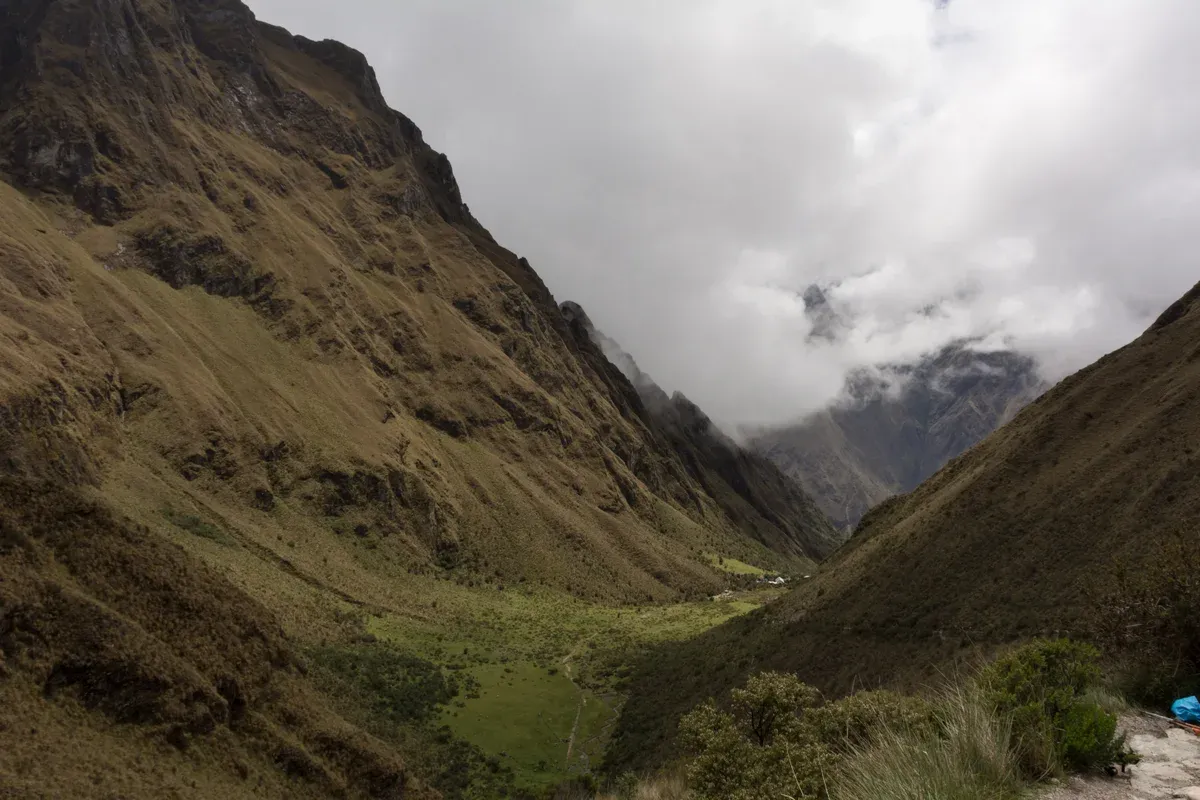
The view from Dead Woman's Pass. Photo: Shriram Rajagopalan, CC BY 2.0, via Wikimedia Commons
How to Hike It
You cannot hike the Inca Trail on your own. Every trekker needs a licensed operator, a permit and a plan booked months ahead.
Licensed Operators Only
Inca Trail permits are sold only through Ministry of Culture authorised agencies, and independent hiking is not allowed. Before the early 2000s more than 1,000 people per day were hiking the trail, so Peru introduced a quota system in 2001. Today permits are capped at 500 people per day, and only about 200 of those are trekkers, the remaining 300 go to guides, porters and support staff.
At the Km 82 checkpoint you must show your original passport while the operator presents permits for trekkers, porters, guides and cooks. Companies that break the porter weight limit risk a heavy fine and loss of licence.
Permits and the February Closure
A permit is issued to one person on one passport, and it is personal, non-transferable and non-refundable. Permits are released once a year on a first-come basis, and peak season permits for May to September sell out fastest. One operator advises booking the classic trail 4 to 6 months ahead for June to August, and 6 to 8 months in advance in general.
The whole trail closes every February for maintenance and reopens on 1 March. About 60 specialists repair stonework, stabilise terraces, clear vegetation and inspect bridges, working from Piscacucho village in Ollantaytambo. February is the height of the rainy season with heavy rain, landslides, fog and swollen rivers, and the 2025 closure ran to late March because of it. Machu Picchu citadel stays open all year even when the trail is closed. Full quotas, opening dates and booking steps are on the Inca Trail permits page.
The Tours, by Type
Every listing below is a bookable tour with a fixed dollar price. Check what each price includes, because not all of them cover the Machu Picchu ticket or the return train.
Classic 4-day treks from Km 82 start at $798 per person with 4-Day Inca Trail with Panoramic Train, which includes the Inca Trail tickets, the Machu Picchu entrance for circuits 1 and 3, a personal porter for 7 kg and the Vistadome panoramic train back. The most reviewed option is 4-Day Inca Trail with Vistadome Train at $835, with 11,562 reviews at a 5.0 rating, where the guide takes all entry fees and the return train class depends on the travel date. 4-Day 3-Night Inca Trail Trek at $998 adds private hotel pickup and free cancellation up to 24 hours before. 4-Day Small-Group Inca Trail at $980 caps the group at 8 and includes a sleeping bag and air mattress. At the top end, Luxury 4-Day Inca Trail costs $6,222 per person and includes massage therapists at every camp and Peruvian wines with the meals.
| Tour | Days | Price | Group | Standout |
|---|---|---|---|---|
| 4-Day Inca Trail with Panoramic Train | 4 | $798 | Up to 16 | Vistadome return, porter 7 kg |
| 4-Day Inca Trail with Vistadome Train | 4 | $835 | Up to 14 | 11,562 reviews at 5.0 |
| 4-Day 3-Night Inca Trail Trek | 4 | $998 | Up to 12 | Private hotel pickup, free cancellation 24h |
| 4-Day Small-Group Inca Trail | 4 | $980 | Up to 8 | Sleeping bag and air mattress included |
| Private 5-Day Inca Trail | 5 | $1,710 | Private | Personal porter 6 kg, hotel night |
| Luxury 4-Day Inca Trail | 4 | $6,222 | Private | Massage therapists, wine with meals |
Longer, Shorter and Hotel-Based Options
Not everyone wants three nights of camping. The 7-Day Salkantay and Inca Trail at $1,555 links the Salkantay route, Humantay Lake and the Classic Inca Trail, with 6 nights of camping including one at Sky Camp in Soraypampa. The 2-day short Inca Trail runs about 12 kilometres from Km 104 and ends at the Sun Gate: Short Inca Trail with 4-Star Hotel at $585 puts you in a 4-star hotel in Machu Picchu town instead of a tent, and the Private One-Day Inca Trail at $596 runs the one-day route from Chachabamba in about 14 hours with a Vistadome glass-roof train back.
For the routes from Cusco to the citadel by train and trail, see Inca Trail to Machu Picchu. For month by month conditions, see the best time to hike the Inca Trail.
Wildlife and Orchids on the Way
The trail crosses the Historic Sanctuary of Machu Picchu, which was established in 1981 and inscribed by UNESCO in 1983. Wikipedia lists 24 ecosystems, 75 mammal species, 444 bird species and 423 orchid species inside the sanctuary, and PROMPERU says the orchid count may exceed 1,000 and counts more than 420 bird species including the Andean condor and the endemic Inca wren.
Mammals you might glimpse include the spectacled bear, puma, Andean fox, white-tailed deer and coati, though Landed Travel calls the mountain viscacha the most reliably visible animal and says spectacled bear sightings near the citadel are extremely rare. The landscape shifts from alpine tundra and Polylepis cloud forest down to rainforest as you descend toward Wiñay Wayna and the Urubamba River.
Sources: Wikipedia: Inca Trail to Machu Picchu, Historic Sanctuary of Machu Picchu, Qhapaq Ñan, Andina, TreXperience, PROMPERU
Inca Trail Tips
Five things that make the trail easier and four mistakes that ruin it, all drawn from the operator rules and official conditions above.
Do
- Do book your permit 6 to 8 months ahead, because permits are capped at 500 people per day, only about 200 go to trekkers and May to September sells out fastest.
- Do spend 2 or 3 nights in Cusco before the trek, because Cusco sits at about 3,400 metres and sleeping altitude should rise by no more than about 500 metres a day above 3,000 metres.
- Do carry your original passport to the Km 82 checkpoint, because permits are tied to the passport and the checkpoint requires identity documents along with the operator's permit list.
- Do train for steps as well as distance, because day 3 alone drops about 1,500 carved stone steps over 1,000 metres of descent to Wiñay Wayna.
- Do confirm what your tour price includes, because the return train is a listed exclusion on the $1,499 Premium 4-Day Inca Trail Trek while the $835 Vistadome trek includes the train.
Don't
- Don't plan the trek in February, because the whole trail closes for maintenance every February and reopens on 1 March.
- Don't expect to change the name on a permit, because permits are personal, non-transferable and non-refundable.
- Don't overload your daypack, because porters may carry at most 20 kg including 4 kg of their own belongings (some sources say 25 kg including 5 kg), and companies that break the weight limit risk fines and loss of licence.
- Don't skip the Machu Picchu ticket details, because trek dates must match the citadel entry dates and the Circuit 3-B allocation for trekkers is scarce and can sell out months in advance.
Inca Trail Questions
Can you still hike the Inca Trail?
Yes. The trail is open from March to January each year, closed every February for maintenance, and hiked only with a licensed operator under a permit quota of 500 people per day, of whom about 200 are trekkers. Permit rules and booking windows are on the Inca Trail permits page.
How hard is the Inca Trail?
Operators rate it moderate to challenging. It covers roughly 42 kilometres (some sources say 44 or 45) with about 2,500 metres of total elevation gain, and the 4 to 5 hour climb to Dead Woman's Pass at about 4,200 metres on day 2 is the hardest stretch. The full profile is in Dead Woman's Pass.
How do I train for the Inca Trail?
Build leg endurance for long days of stair climbing at altitude, since the trail is stone steps and day 3 alone descends roughly 1,500 steps over 1,000 metres. Acclimatise in Cusco first, which sits at about 3,400 metres, and follow the rule that sleeping altitude rises no more than about 500 metres a day. The homepage guide to luxury Inca Trail tours explains how a personal porter lightens the load.
What is the easiest version of the Inca Trail?
The short Inca Trail from Km 104, which runs about 12 kilometres in 6 to 7 hours at around 2,200 metres and is rated moderate, and it still passes Wiñay Wayna and finishes at the Sun Gate. Short Inca Trail with 4-Star Hotel is a 2-day version at $585 with a hotel night.
How much does an Inca Trail tour cost?
Classic 4-day treks on this site run from $798 per person with the Vistadome panoramic return to $6,222 for a fully private luxury trek with massage therapists and wine at camp. Compare them in the comparison table on the homepage.
Do Inca Trail hikers need a separate Machu Picchu ticket?
Many bookable tours include the citadel entry, but not all do, so check the listing. Trekking permits use Circuit 3-B, which covers the agricultural zone, the Temple of the Sun and the House of the Inca, and that allocation is scarce and can sell out months ahead. Ticket details are on Inca Trail to Machu Picchu.
The 4-Day Inca Trail with Vistadome Train at $835 per person carries a personal porter for 7 kg, includes the entry fees and a return train whose class depends on the travel date.
5.0 rating from 11,562 reviews